Many years ago, Natasha Frost-Savio took part in a Pink Ribbon awareness walk in LA. “This was way more than a pretty stroll in pink clothes,” she says. “It was a day of women’s empowerment, women supporting women and joyful sisterhood.”
Natasha decided then and there to bring “some of that positive vibe” back to her beloved Monaco. Since she set up Pink Ribbon Monaco back in 2011, the non-profit’s annual 5km Pink Ribbon Port-to-Palace walk (this year on February 12) has become one of the biggest events for the community with participation over the years from Prince Albert and government officials. Pink Ribbon Monaco importantly included English-language and actions, to involve the British and anglophone community.
As it strives to promote early detection and awareness, it is also the first association in the region to celebrate Pink October – Breast Cancer Awareness Month – and to illuminate buildings in the Principality in pink. In close collaboration with the Prince’s government, the National Council, the Ministry of Health and Social Services and in partnership with the Princess Grace Hospital Centre, Pink Ribbon Monaco has been promoting awareness, health and solidarity for more than a decade.
Natasha’s tireless campaigning effort was recognised on National Day last year when she was knighted the Order of Saint Charles by Prince Albert on November 17, 2022, for her services to the State.
Never one rest on her laurels, Anglo-American Natasha is organising Pink Ribbon Monaco’s first gala and charity auction on February 10 to raise funds for a scientific study of new screening methods for lobular breast cancer at the Princess Grace Hospital Centre. The “Dare to Bear” event at the Hotel Hermitage’s Salle Belle Epoque will include special guest American actor of TV’s ER fame Noah Wyle, who recently had a relative diagnosed with breast cancer, will also participate in the Pink Ribbon Walk on February 12.
“Playing on the double meaning of the English word bare and bear, Pink Ribbon Monaco hopes to de-dramatize breast cancer screening,” explains Natasha. “Dare To Bear – bare your breasts – is a pun encouraging women to get routine screenings. By replacing bare with bear, a familiar and beloved object becomes the rallying call of all women, encouraging them to arrange a screening appointment.”
The February 10 charity auction will include a variety of lots, ranging from five photo prints and rare Technicolour 35mm slides from Alfred Hitchcock’s Rear Window of Grace Kelly and James Stewart to unique experiences, including VIP terrace access for the Sunday of the Monaco Grand Prix.
“The Hitchcock film elements are sections of dye transfer prints that Technicolor Hollywood produced for James Katz and Robert Harris in the 1990s,” describes Natasha, whose father was an American film producer with United Artists then VP at Universal before founding and heading the Classics Division (he worked with the Beatles, Bowie, Scorsese, Kubrick and Mohamed Ali).
“These original camera negatives of cinematographic history were inter-positively duplicated from the deteriorated original prints to create a ‘duplicated negative’, fully restoring Hitchcock’s original masterpieces.”
Certified technicolour 35mm slides of Grace Kelly will be up for auction.
Also up for auction: Two exclusive passes for the Hotel Hermitage’s Midi Terrace VIP Formula One all-inclusive package for Sunday race day, an FB AURA Patriot tourbillon watch, an XL Dare to Bear sculpture donated by Segraeti, a bespoke pink quartz and diamond ring by VITALE 1913, a Momma’s Blues custom-made Pink Ribbon jacket, a sitting with artist Toby Wright for a charcoal portrait and two donations by J&T Concierge Monaco – a limited edition Mont Blanc Grace Kelly pen and (TBC) two nights for two in a luxury hotel in London along with a donation from Aero for two one-way tickets on a semi-private jet.
Stars’N’Bars cofounders Didier Rubiolo and Kate Powers. Photo: Nancy Heslin
In my last interview with Kate Powers, in November 2020, the late cofounder of Stars’N’Bars told me, “Lockdown helped us to wake up to necessary ecological changes that were more important than economical ones. Stars’N’Bars is only getting started on their ecological journey.”
Although at the time she could not reveal details about the vision she and cofounder Didier Rubiolo had planned, she did say, “We realise how much people don’t like change but if we want to make a difference, we must change our habits. The planet can do without us but we can’t do without the planet. There will big changes in spring 2021.”
Kate’s death in August 2021 overshadowed the transformation of Stars’N’Bars but now it is official that Monaco’s go-to family-friendly restaurant for nearly 30 years – where Prince once played a secret concert, where Michael Schumacher drank victory beers with his racing team and where Prince Albert and his daughter Jazmin Grace took part in the annual Quiz Night – will close its doors permanently on January 27.
“It has been an honour to serve millions of guests from all over the world and we especially want to thank the Monaco community for its amazing support,” expresses Didier, who started Stars’N’Bars with Kate back in ’93 to provide regular people beyond the jet-setters “reasonably priced and quality dining outside the home.” The pair converted an abandoned warehouse into what is today an 1800-square-metre hospitality centre with over half a million customers served every year.
A classically-trained chef with experience in gastronomic restaurants in France and Monaco, Didier first met Kate at her family-run “Le Texan”, the first Tex-Mex restaurant in Monaco and a favourite of Prince Rainier (who gave it the name). Didier went on to revolutionise Monaco’s dining scene by upgrading American Tex-Mex fare at Stars’N’Bars to eventually incorporating an international selection of Asian, Indian and Middle Eastern dishes. Kate may have been more in the public eye over the years, but it was Didier who drove “the restaurant’s shift towards vegetarian and vegan options.
“When Kate and I opened Stars’N’Bars we wanted to give Monaco something new, original and exciting.” Didier recalls. “Our concept was a great success but eventually we realized that we wanted to make a bigger difference in the wellbeing of our community and the planet, especially for our children.”
Stars’N’Bars began developing a “healthier dining experience” and supporting Prince Albert’s environmental protection efforts, including adopting renewable energy sources, finding new ways to reducing waste and creating the first Monaco-based urban vegetable garden as a source of fresh produce and seasonings for restaurant use.
Didier Rubiolo on 2021 World Clean Up Day distributing pocket ashtrays. Photo: Instagram starsnbarsmc
Kate and Didier joined other eco-conscious activists in Monaco to create MONACOLOGY, the week-long educational experience every June to help school children learn how to respect their planet. “We all need to accept that climate change threatens the planet and our children’s lives. Kate and I decided that we wanted to raise conscientiousness about that threat and help the community find solutions,” Didier highlights.
The avid cyclist adds, “It will be sad to say goodbye to Stars’N’Bars after 30 years but it’s time to create something even more special. We will be releasing details of a new project soon and we can’t wait to take the next step!”
Didier, Annette Anderson and the Stars’N’Bars team plan to make the most of the next two months by hosting special animations along with reintroducing popular “nostalgia” blast-from the-past dishes that are not on the current menu. Their social media feed will include throwback images and videos from “unforgettable events over the last three decades, including Halloween, the Fourth of July, Grand Prix, a concert by Prince and surprise visits by international celebrities.”
Kate Powers and Annette Anderson celebrating Fourth of July.. Photo: Instagram starsnbarsmc
And you, the much-loved community who have helped make Stars’N’Bars the institution it has become, will be invited to post your favourite Stars’N’Bars memory to help create a permanent online “living history” of the restaurant. Photo opportunities will be staged for those who want to be “immortalised” as part of the famous restaurant décor and atmosphere before it disappears forever in January.
“Everyone wants to know about our new next step but we really want to focus the last two months of Stars’N’Bars on celebrating 30 years of amazing memories with our customers and staff,” shares Annette.
Stars’N’Bars has always been there for us. Let’s be there for them until January 27 when the doors close for the last time. As Kate always said, “Do what you love. Love what you do. And make a difference.”
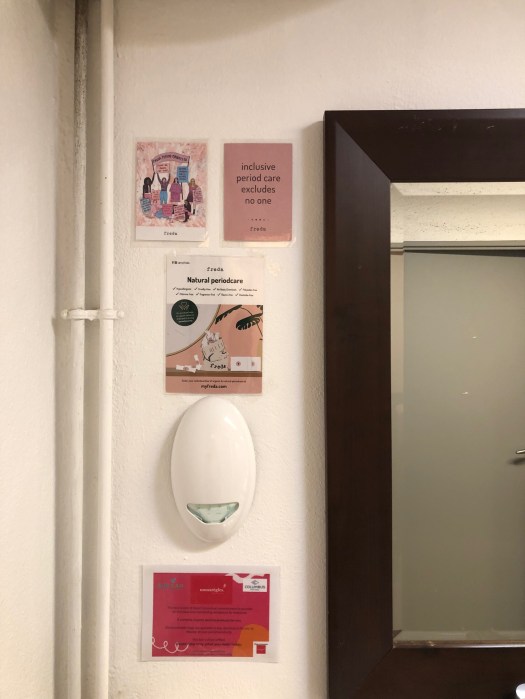
In March of this year, Red Box Project Monaco became Monarègles, a campaign that looks to break the taboo around periods and advocate the wider distribution of organic period protection to young girls in the Principality and, in particular, to young athletes.
The initiative comes from the Monaco association SheCanHeCan (SCHC), run by its unstoppable founder Vibeke Thomson. “Red Box Project Monaco was designed for schools,” explains Vibeke, “encouraging them to provide free period products for their students. In 2022, we changed the name to Monarègles to include companies and institutions. The Columbus Hotel is the first hotel to sign up in Monaco and from Wednesday, the largest private sector employer in Monaco, SBM Offshore will also provide period products via Monarègles to their teams.”
From Friday, SCHC will offer its First Periods Kits to young players in the U14 and U15 categories of ASM FF (women’s football). Céline Cottalorda, who heads the committee to promote and safeguard women’s rights in the Principality, will be on hand.
“The aim in providing Kits to the ASM FF is threefold,” says Vibeke. “First, to inform young players about their periods and the impact it might have on their performance. Second, to inform them about the importance of using organic products, which are better for them and for the planet – and also to advise them which products are best for their bodies. And third, to promote an open discussion and answer questions to help break the taboo around periods.”
First Periods Kits offered to young players in the U14 and U15 categories of ASM FF.
The teenagers will also receive the guide “Everything about your first periods” designed by SCHC which talks about physical and emotional changes, different period products and how men and boys can best support girls on their periods.
The kit also includes a packet containing 18 period protections from the English brand Freda, 1 sachet of FabLittleBag. Kits were also distributed by SCHC at the Don Bosco school in Nice with the financial support of CFM Indosuez.
On October 11, SCHC celebrated the Day of the Girl for the fifth consecutive year at the Conseil National but this was the first official event for parliament’s new president, Brigitte Boccones-Pages. “It was highly significant that the event took place a few days after her election as for the first time, students could witness a woman holding the highest office within the National Council, as well as the many female MPs. It reminds me of the saying – ‘You can’t be what you can’t see.’ And it’s a great inspiration for all students to see a woman president for the first time.”
By signing up to Monarègles with SCHC, companies commit to providing free period products to their teams and, in turn, through their commitment SCHC is also able to give back to the community and provide more period products to schools and women in need, such as refugees and victims of domestic violence.
SheCanHeCan was created in 2011 to help individuals to challenge gender stereotypes.
Period products in the staff bathrooms of Columbus Hotel.
Alicia Sedgwick, author of Communicating Through Change: Lessons Learned From Real Life, teaches Public Speaking, Presentation and Communication Skills at the International University of Monaco. She also works with all backgrounds and all ages, from corporations to private clients and students at the International School of Monaco (ISM). “It is so interesting that small children in their early years can talk freely and chatter without filter but then when they get to primary school age, all that lack of inhibition becomes clouded and they close up.”
Alicia says her training helps students “to open up again, to be free of worries, cares and anxieties when they communicate so they can move through their teens and into adulthood with their self-esteem raised, and the ability to communicate effectively.” And confidence in communicating is essential whether it be through digital communication (online, social media, Zoom), for school or university presentations, or for personal and professional relationships.
Which is why the TEDxYouth event this Saturday, October 15, from 2-4 pm, at ISM is such a huge deal. Its speakers are all ISM students ages 10 to 17. “The aim is not only to raise the profile of TEDxYouth, but to promote its significance as the only TEDxYouth event in the Principality,” says Alicia. This event is open to the public and you can register and sign up for a ticket ( €10) directly from the International School of Monaco website.
“So many of the children who do put themselves forward for the TEDxYouth auditions are way out of their comfort zone. I have had students who speak so quietly, or shift about when they talk, and do not engage, then perform at TEDxYouth with such power and control that I am so impressed and proud.”
The international platform of students presenting include Amael Anwar (Switzerland), Olivia Chisholm (UK and South Africa), Solomon Passegger (Austria), Sophia Zweegers (Morocco and the Netherlands), Margherita Sparaco (Italy), Amelia Banks Clark (UK) and well as Celeste Maximiana Schofield.
Speaker Amali Benner shares, “A lot of my friends call me a chatterbox because I talk so much. But I recently learned that talking just for the sake of talking is rambling and purely a waste of words. I joined TEDxYouth to, like most people, improve my speaking skills.”
For 10-year-old Alexandra Vlad (France and Romania), “I joined TEDx to improve my confidence on stage and possibly to help defeat my slight stage fright. Also, I want to improve my ability to really express myself. In the past I have sometimes been afraid to express myself because I thought that nobody would really listen to me, but it’s such a relief to speak and to know that everyone is listening to me.”
ISM recently held a successful Quiz Night to raise awareness for this second edition of TEDxYouth. “Shasta Almi, the school’s Marketing and Public Relations Coordinator, and Director of Studies Hannah Gettel, who serves on the organising committee, are incredible women and have been amazingly dedicated to the TEDxYouth event.”
I was shocked when I heard that Father Peter Jackson, 69, had died on August 30. Having suffered a pulmonary embolism, he passed away a few days later in hospital surrounded by family and friends. In the words of many, he genuinely was “one of the kindest people I had ever met.” A eucharist at Holy Trinity Nice will take place at 11 am on Wednesday, October 12 will be followed by the committal of ashes in the church yard. There will be a private cremation in advance.
Father Peter came to Holy Trinity Nice in October 2014. During my years as Editor-in-Chief of the Riviera Reporter magazine, I had the privilege to sit down with him several times after he first arrived, which happened to be mere months before the Charlie Hebdo massacre. Uncannily, he was also in Washington as 9/11 unfolded, driving across the bridge as the Pentagon was hit. The story below is based on two interviews, from March 2015 and November 2015, when he reflected on the Paris attacks and the fundamental human question about how could God allow suffering.
It was All Saint’s Day 1945 when Peter Jackson’s parents met on an air force station in Hartlebury, Worcestershire. They married two years later and moved to Wales where Peter was born in 1953.
“I attended a small private school from the age of 13 to nearly 18, and I stayed on to do an extra study for Oxford entrance. I worked for the newspaper – not as a journalist but folding and delivering papers to make some money so I could travel to the South of France. In fact, I spent my 18th birthday closed to Toulon.”
Peter read theology at St Peter’s College Oxford for three years before starting to study Law but went back to Oxford and got a teaching qualification. From there, he went on to Theological College at St Stephen’s House in Oxford and trained to be ordained.
“When I was in my prep school of 150 boys, the headmaster commented to my mother ‘Brother Peter’, so even though I wasn’t particularly pious, there must have been something religious about my attitudes. And the other thing I do remember is my scripture lessons. Our teacher was quite obsessed with spiritualist things and these were some of the liveliest lessons. My rival in this tiny school, Nick Rowley, eventually went to Cambridge and was a brilliant musician who played for the Two Ronnies. He and I were absolutely engaged in thinking about religion and philosophy, the big issues that concern us as we are growing up.”
After confirmation, Peter found going to chapel significant and admired his “very abled” Chaplain, and the idea that this is what he would do crossed his mind. “But I also experienced the common teenage reaction to all the suffering in the world, we’re talking about the late Sixties and Vietnam. I wasn’t becoming an atheist but I now realise the fundamental human question about how could God allow such suffering is actually growing up in terms of spirituality, a fairly normal adolescence for a thoughtful person. At the time you just feel quite angry. I didn’t stop going to church but I felt very conflicted, which fell into a time when I was fascinated by Bertrand Russell; I read all three volumes of his biography and read transcripts of his debates on religion in the early Fifties, which now you could probably watch on YouTube. It all makes you wonder whether God exists, and if he does, why does so much appalling suffering go unrectified?”
He added, “The institution on the whole didn’t give me greatest confidence. I resisted being ordained but I saw that I was resisting, and that wasn’t a good thing. I wasn’t sure. It was such a relief, though, and I felt like I had arrived at the right place.”
Father Peter said the question of suffering was one he was often asked. “If there’s a sudden death or a young person is afflicted with some awful illness, or, as in my last parish, the youngest son of our treasurer’s wife was murdered in his twenties in a random attack around the corner from where I lived. It’s not that they stopped believing, but they didn’t. Faith and my connection with them pastorally didn’t waiver, but it left them in a very bleak place. I read that Mother Theresa in the last few years of her life found a complete emptiness when she prayed. I made this commitment and I will hold onto this even though they get nothing back in terms of feeling.”
He believed it was possible to “hang in there” even though one’s intuition or affective side is desolate. Much like people felt after the Charlie Hebdo attack in Paris, where two armed terrorists killed 12 people and injured 11 others in the office of the weekly satirical newspaper.
“I didn’t preach about Charlie Hebdo. You have to be very careful about preaching about these subjects, you can characterize it as the conflict between two faiths, or two brothers who lived marginalised lives, and it doesn’t work. It’s essentially many different interpretations, and I don’t think in public, giving an opinion is helpful. Frankly, we don’t know.”
Father Peter was in Washington on 9/11. “I was driving across the bridge as the Pentagon was hit. I’d oddly been right in the mix so to speak. We cannot understand how shocked Americans were about being attacked in their home country and we can get lost in a fog of complexity. What I did in the very thoughtful and highly educated episcopal parish in Washington was a whole series about the ethics of war. I found those who were pastorally engaged, they didn’t want a knee-jerk reaction but to consider the wider context of what this was all about.
“One of the consequences of the First World War was a change in how people thought about the dead. They wouldn’t have a very adequate response to death and grief, but you have the ritual of the unknown soldier and poppies, two minutes silence and you suddenly get changed emphasis in Anglicanism, get prayers for the dead.
“In the Second World War, people, not everyone, went to church. The intensity of the experience drew people to the church for a secular memorial service. There isn’t religious behaviour in our society, but institutions or religion and their representatives connect with the raw emoting and questioning of the moment.
“By inclination, evocative sacramental religion gives people more of a resource to cope. People can be themselves and have their own relationship with God.”
A year after his arrival as Chaplain at the historic Holy Trinity Anglican Church in Nice, as well as of St Hugh Vence, Father Peter said in 2015, “I have served in a variety of parishes and schools, including twelve years at Harrow School, but I have never received such a warm and practical welcome as here.
“We have had so much help in settling into the presbytery – the 1890s priest’s house next to the church – getting to know the community and becoming accustomed to life in France. The assistance offered was invaluable as Holy Trinity is quite different from my previous parish in London. The congregation there consistently drew from only the immediate area, while the Nice one is constantly changing. There is a loyal core of people who have made their permanent home here but there is also a constant flow of visitors from all over the Anglophone world. In recent months, we have welcomed students from the Netherlands, Australia and the US, a Canadian Air Force chaplain, as well as visitors from the UK and North America. There are also those who come for a few months at a time: some from Canada wintering on the Riviera, as the British did in the nineteenth century, and others simply spending time in apartments that they own in Nice.
“There is also a significant American presence, which dates back to the time 40 years ago when the American Anglican congregation of the Episcopal Church of the Holy Spirit joined Holy Trinity, having sold their church in Nice to the French Protestants. This explains why Holy Trinity, a chaplaincy within the Church of England Diocese in Europe, is also listed as an associated parish by the Episcopal Church. Attendance, as well the composition of the congregation, varies considerably.
“We had almost 300 in church for the Easter Day service but fewer than half that number at Christmas, reflecting both the tendency of many permanent Nice residents to visit family at Christmas and the popularity of the Riviera as a holiday destination at Easter. When I describe the Holy Trinity congregation to visiting friends, I say that they are more like a cathedral congregation than a parish one. The factors that draw people to us are similar: a desire to participate in worship in English, and worship, that is accessible and mainstream.
“Also, I cannot assume that everyone is Anglican or that everyone is equally devout: some may be seeking something spiritual without yet having strong commitment. Moreover, the social time after services, when many linger to chat over a glass of wine or a cup of coffee, is for some an indispensable complement to the worship – English speakers in a foreign land, they are keen to find an English-speaking community. But this has to be balanced by a recognition that some are also attracted by the fact that you can also slip in and out of Holy Trinity without the obligation to become more involved.
“I am very fortunate. I have had a variety in my life of working with interesting communities and met an extraordinary range of people and become involved profoundly in the lives of others. And that’s a privilege that doesn’t happen to a lot of people. I’m grateful that I have a family life, which was not something I expected. And fascinated to have arrived in such an extraordinary place and community and house, and at a point when one might expect to be winding down and retiring, I find myself with the stimulus of something entirely new and rewarding.”
Father Peter is survived by his husband Joseph Voelker and their children Eliot and Anneli.
I discovered Monaco had a chess club back in 2017. It was during the #Whitecard photo op at the Monaco Yacht Club where a slew of sports celebrities had gathered to show support for the Peace and Sport initiative. Following the group shot, Prince Albert turned to his right to speak with Fiorina Berezovsky (pictured below), Monaco’s youngest ever national chess champion.
At age nine, Fiorina had already been playing the game for three and a half years and was a member of Le Cercle d’Echecs de Monte-Carlo (CEMC) – Monaco’s Chess Federation. She also spoke five languages – Ukrainian, French, English, German and Russian.
Monaco Champions for Peace at 2017 #Whitecard event. Photo; Manuel Vitali/Direction de la CommunicationPhoto: Jean Michel Rapaire Facebook
Now age 14, Fiorina (above) is part of the Monaco Women’s Team competing at the 44th Chess Olympiad 2022, which takes place in Chennai, India, from July 28th to August 10th August. With 100 countries registered for the event, she is the youngest participant.
The Women’s Team will be captained by Fiorina’s mom, Svetlana, who is also a Monaco Women’s Chess Champion; Fiorina’s father, Igor, holds an international chess title. The couple, who met at a chess tournament in Ukraine, have been extremely active in assisting Ukrainian refugees arriving in Monaco.
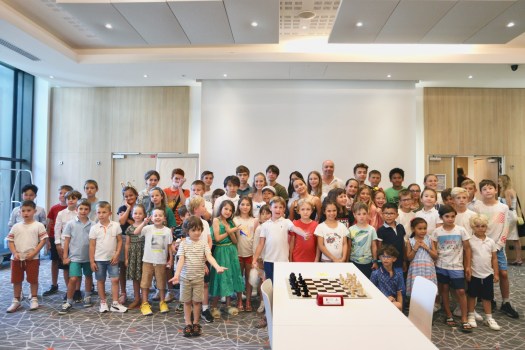
When Igor and CEMC president Jean Michel Rapaire decided to organise a “Chess for Peace” tournament for players ages 5 to 17, they never imagined such an overwhelming response. Fifty-six young players – including 14 girls – from the Cercle d’Echecs de Monte-Carlo registered. The event had to be moved from the chess club on boulevard d’Italie to the Novotel to accommodate everyone.
The fast-play tournament on Sunday, June 12th was based on 9 rounds of 10 minutes plus 5 seconds per move.
What makes Sunday’s “Chess for Peace” event exemplary is that ten of the young players are Ukrainian refugees. “As chess is popular in Ukraine, most kids came with a certain level,” explains Igor.
“Thanks to my wife’s great work, Ukrainian kids new to the region have gravitated towards the chess club.”
RESULTS AFTER FOUR ROUNDS 1st-2nd Fiorina and Aaron 4 points 3rd-4th Boris and Sergej with 3.5 points 5th-14th Nam Thao , Stanislav, Nikita, Lukas Dante, Alina , Alexander, Egor, Valériia and Janibek
Photo: Jean Michel Rapaire FacebookPhoto: Nam Thao Facebook
I last spoke with Burton Gintell at the American Club of the Riviera’s Thanksgiving lunch in November. Chatting in the Salle Belle Epoque, his genuine kind self inquired with a twinkle, “How are you doing Nancy … really?” And yet he was with the pancreatic cancer diagnosis.
After several minutes, we were talking about one of my all-time favourite stories: how Burton happened to meet Fred Astaire in New York on their shared birthday on May 11.
Burton and I were anecdotal and chatty, as we had been since we first met years ago when I worked at the Riviera Reporter and he was in his first mandate as president of the American Club of the Riviera (ACR), a position he held from 2010-2011 and from mid-2013 to 2016; he also co-presided in 2017 with Beathe-Jeanette Lunde.
In 2011, the Reporter had done a piece on the annual conference on the Association of Presidents of the American Club, which Burton hosted at the Monaco Novotel with representatives from 15 countries in Europe. He remarked in the article, “The business component is rather smaller now as fewer firms are sending staff abroad. Talking to our guests, I heard that in some places business networking can still be a significant function of a club, in others there’s a strong interest in political issues. Here our emphasis is a blend of the social and the cultural.”
Burton, a trained CPA who was an Emeritus Member of the Board at Sophia Business Angels, strived to develop unique events for ACR members, such as a pre-lunch visit to Nice’s Museum of Historical Musical Instruments, whose curator Robert Adelson was American.
One of the most memorable ACR events I was invited to was a few years back, when the club celebrated Christmas with a beer tasting session at the then-new microbrewery in Nice, Allez Hops!, owned by ACR governor, Daniel Deganutti.
Ever the gentleman, Burton and his British realtor wife Jackie Pressman-Gintell, have always been kindhearted towards me. The couple lived in Europe for more than 40 years, and spent the last two decades in Cannes where both have been active members of the community and supporters of several French arts organisations.
Burton was a director and founding shareholder of Innovation Europe S.A., an investment vehicle created by SBA to invest in a portfolio of innovative young companies. I did not know this but he had received the Queen’s Award for Export Achievement in the UK during one tenure as chief executive at a major company. In addition to his presidency at ACR, he was vice-chair for three years of the Côte D’Azur-Monaco chapter of the American Chamber of Commerce in France.
At ACR’s “Swell-egant Elegant Gala” at the Belles Rives, Burton commented, “Virtually all of us here have enriched our lives by living elsewhere from our birthplaces, to which some of our families migrated to seek a better life. We can perhaps pause for a moment to reflect upon those who do not have our choices.”
He was a compassionate and giving man who often reflected on others’ needs. Cy Todd, ACR vice-president and membership coordinator, added this reflection on Burton: “He was an ‘influencer’ before the term’s time. His friendly and inclusive demeanour drew people to him. This made him the perfect president of the American Club. He was like a Pied Piper, even taking a group of friends to his beloved Venice, to celebrate his and Jackie’s 25th wedding anniversary. It was a wonderful trip, enjoyed by all.”
Burton died on April 30 just shy of his 87th birthday. Jackie shared the message: “My darling husband, Burton Gintell, passed away this morning. He will be missed by all who loved the extraordinary man he was.”
He will be cremated on May 11th at 11 am at the Cannes crematorium (Chemin plaine de Laval, 06150 Cannes la Bocca).
I will not be able to attend but at 11 am, I will do my best Fred Astaire moves in his honour.
March 8 is International Women’s Day. To mark the occasion this Tuesday, I am organising at StarsnBars a collection to support Ukraine.
Two of my colleagues are Ukrainian: one is currently being bombed; the other is here but her father is not. He has stayed in Ukraine and is working with the local government and preparing to defend his pays natal.
Like many of you I feel helpless. I see images on TV of brave-faced Ukrainian women who are trying to flee with their young children, with their lives stuffed in one suitcase. I see young women, middle-aged women and not so middle-aged women who are staying and arming themselves with rifles. I see women and their families in Russia defying imprisonment as they unprecedentedly protest to end the war on their neighbouring friends. This is all, by definition, courage.
Courage does not care how much money you have or what nationality you are. Courage is not easy, it takes effort to find your voice. But one voice can turn into two which turns into 200 which turns into 200,000 which turns into 2 million.
I am asking to hear your voice on International Women’s Day. We have lived in isolation for two years and now is our time to come together and to shine a collective light on Monaco, a community that shares a global conscience united through benevolence, compassion and love.
Here is where you come in.
9am to 10am Monaco Stands Together I invite everyone who works, lives and plays in Monaco to come together outside of Starsnbars and #standwithukraine. It is International Women’s Day and I would love to see as many female faces as possible – moms, entrepreneurs, those working with nonprofits or in commerce, clubs and associations members, artists, athletes or retired – but this is a 100% inclusive event. Everyone is welcome to come and chat, network, order coffee at StarsnBars, hug … to connect.
Should you feel inspired, wear a dash of yellow or cyan blue for the Ukraine flag, orange for Kate Powers or purple for International Women’s Day.
9am to 7pm Red Cross Monaco The Red Cross Monegasque (RCM) has kindly agreed to give a collection box for cash or cheque donations to Ukraine. Cheques need to be made out to: Croix-Rouge Monégasque – Ukraine.
All cash and cheque donations to RCM on Tuesday will be made in the name of the Kate Powers Foundation.
Please note the RCM is not accepting items of any kind. You can also send a cheque direct to Croix-Rouge Monégasque at 27 Bd de Suisse, 98000 Monaco.
9am to 7pm Drive for Ukraine There will be a collection of items for Ukraine outside of StarsnBars. I have organised with my Ukrainian colleague a driver in the community and point of contact in Ukraine to ensure these items are driven to the border where they will then be picked up and taken to various cities within the country. Many donated items from around the world are making it to the border but not able to be distributed in Ukraine itself. Some are making it across the border only to end up in the hands of those selling on the black market.
This is a part of a list sent today to my colleague from a volunteer in Ukraine. The focus here is on women and babies. These items are probably not in your closet but a little effort on your part will go a long way.
– antiseptics – anti-inflammatories – antispasmodics – hydroalcoholic gel – needle and thread – hygienic wipes – baby wipes – Pampers – baby food, baby milk – baby clothes (socks), baby toys – anything for newborns – pet food – feminine hygiene products – toiletries, especially toothbrush, toothpaste and soap, baby shampoo
Please share this information to encourage others to support this humanitarian cause on March 8.
Thanks to Annette Anderson and Didier Rubiolo at Starsnbars, Françoise Cellario at the Croix-Rouge Monegasque, Yana Kryshtofovych and Merrily Lustig Tornatore, who have all helped pull this together last minute.
Le 8 mars est la Journée Internationale de la Femme. Pour marquer l’évènement ce mardi, j’organise au StarsnBars une collecte pour soutenir l’Ukraine.
Deux de mes collègues sont ukrainiennes : l’une vit actuellement sur les bombes ; l’autre est ici mais pas son père. Il est resté en Ukraine et travaille avec le gouvernement local et se prépare à défendre son pays natal.
Comme beaucoup d’entre vous, je me sens impuissante. Je vois à la télévision des images de femmes ukrainiennes au visage courageux qui tentent de fuir avec leurs jeunes enfants, toute leur vie enfouie dans une seule valise. Je vois des jeunes femmes, des femmes en pleine force de l’âge et des femmes même plus âgées qui restent et s’arment de fusils. Je vois des femmes et leurs familles en Russie défier l’emprisonnement alors qu’elles protestent sans précédent pour mettre fin à la guerre contre leurs amis et voisins. C’est tout simplement du courage.
Le courage n’est pas une question de combien d’argent vous avez ou de quelle nationalité vous êtes. Le courage n’est pas facile, il faut des efforts pour oser parler. Mais une voix peut se transformer en deux qui se transforment en 200 qui se transforment en 200 000 qui se transforment en 2 millions.
Je demande à entendre votre voix à l’occasion de la Journée internationale de la Femme. Nous avons vécu isolés pendant deux annéss et il est maintenant temps de nous rassembler et de faire rayonner ensemble Monaco, une communauté qui partage une conscience globale unie par la bienveillance, la compassion et l’amour.
Voici comment vous pouvez aider.
9h à 10h Monaco Stands Together J’invite tous ceux qui travaillent, vivent et jouent à Monaco à se rassembler en dehors de Starsnbars et de #standwithukraine. C’est la Journée Internationale de la Femme et j’aimerais voir autant de visages féminins que possible – mamans, entrepreneures, celles qui travaillent avec des organisations à but non lucratif ou dans le commerce, membres de clubs et d’associations, artistes, athlètes ou retraitées – mais c’est un événement 100% inclusif. Tout le monde est le bienvenu pour venir discuter, “network”, commander un café au StarsnBars, faire un câlin ou autre. Il s’agit d’être solidaires
Si vous vous sentez inspiré, portez une touche de jaune ou de bleu cyan pour le drapeau ukrainien, orange pour Kate Powers ou violet pour la Journée Internationale de la Femme.
9h à 19h Croix-Rouge Monégasque La Croix-Rouge Monégasque (CRM) a aimablement accepté de mettre à disposition une boîte de collecte pour les dons en espèces ou en chèques à destination de l’Ukraine. Les chèques sont à libeller à l’ordre de : Croix-Rouge Monégasque – Ukraine.
Tous les dons en espèces et en chèques à CRM mardi seront faits au nom de la Fondation Kate Powers.
La CRM n’accepte aucun article de quelque nature que ce soit. Vous pouvez également adresser un chèque directement à la Croix-Rouge Monégasque, 27 Bd de Suisse, 98000 Monaco.
9h à 19h Drive pour Ukraine Il y aura une collecte d’articles pour l’Ukraine devant StarsnBars. J’ai organisé avec mon collègue ukrainien un chauffeur de la communauté, et aussi un point de contact en Ukraine pour s’assurer que ces articles soient conduits à la frontière où ils seront ensuite récupérés et transportés dans différentes villes du pays. De nombreux articles donnés du monde entier arrivent à la frontière mais ne peuvent pas être distribués en Ukraine même. Certains traversent la frontière pour se retrouver entre les mains de ceux qui vendent au marché noir.
Ceci fait partie d’une liste envoyée vendredi à mon collègue par un volontaire en Ukraine. Le focus mis ici est sur les femmes et les bébés. Ces articles ne sont probablement pas dans votre garde-robe, mais un petit effort de votre part fera beaucoup de chemin.
– antiseptiques – anti-inflammatoires – antispasmodiques – gel hydroalcoolique – aiguille et fil – des lingettes hygiéniques – lingettes pour bébés – Pampers – nourriture pour bébé, lait pour bébé – vêtements bébé (chaussettes), jouets bébé – tout pour les nouveau-nés – la nourriture pour animaux – produits d’hygiène féminine – articles de toilette, notamment brosse à dents, dentifrice et savon, shampoing pour bébé
Veuillez partager cette information pour encourager les autres à soutenir cette cause humanitaire le 8 mars.
Merci à Annette Anderson et Didier Rubiolo au Starsnbars, Françoise Cellario à la Croix-Rouge Monégasque, Yana Kryshtofovych et Merrily Lustig Tornatore, qui ont tous contribué à l’organisation de la dernière minute.
Soyons solidaires Monaco. Rendez-vous tous mardi 8 mars 2022 à 09h au StarsnBar, quai Antoine 1er.
My inaugural open water came in the summer 2012. I had signed up for my first triathlon, the Ironman 70.3 Pays d’Aix-en-Provence, for September of that year. I needed to get comfortable in the water as opposed to the Olympic-distance pool in Nice where I had been training.
Considering I had not swm since my teens, at the age of 43 I was a reasonably strong swimmer thanks to endless childhood summers at our family cottage in Canada. Swimming in a lake and swimming in the Mediterranean Sea, however, are two different ball games, especially when the warm currents in the Med in the South of France favour jellyfish.
That first swim with my ever-patient husband is a memory we both chuckle over to this day. Embarrassing to admit, I thought my air bubbles were jellyfish. When I was not literally swimming on top of my husband for protection, I was stopping because the fear of jellyfish was interfering with my breathing. We maybe swam 500 meters that day before I’d had enough but I quickly understood the vital relationship between controlled breathing and open water swimming.
A decade later, and thanks to swimrunning, the sea provides a connection to nature that I simply cannot live without. In the winter season, when the water here can be between 10°C and 14°C, I still manage two to three 5-6km swims a week, depending on the weather.
As openwater swimmers and swimrunners, we take all the necessary precautions, from swimming when possible with a buddy and with a visible safety buoy to sticking close to the shoreline and being smart about marine conditions.
I am not what you would call a risk taker. I may push myself out of my comfort zone but I am overly cautious in everything I do in and out of the water. I swim year-round in swimrun shoes, so I can exit at any time should I need to – a jellyfish infestation, change in swell, feeling cold or unwell. Before every swim, I ask myself: what am I dealing with today? I look at my course from the shore. We have paragliders who offseason land on the beach and so there are security boats. I have many times mentally prepared myself for the possibility of a paraglider falling on me.
There are fears about open water swimming that we share. Some we talk about, like jellyfish (I have lost count on how many times I have been stung although I have several scars to remind me) and cold water (having succumb to hypothermia during a swimrun race I know the difference between mental cold and physical cold). Then there are the dreads in the back of our minds that we don’t talk about: more dangerous marine life, such as sharks, and the fear of getting hit by a boat.
I don’t have to worry about sharks but I got hit by a boat. So let’s talk about it.
****************
On Sunday, February 6, I did my regular 5km swim with ideal winter conditions: calm sea, clear skies and no wind. The water was 14°C. I had a bright orange safety buoy attached and looked up often to check my direction and for any boats. With cold water swimming, the longer I am in the water the more likely I can become disoriented so I am vigilant about maintaining visuals.
With less than 200 meters to shore to end my swim, an oval shadow appeared overhead and I thought it was a paraglider falling in the sea. Instead of stopping suddenly, I kept my course so the paraglider could calculate my direction and avoid hitting me. I learned this from rowing. Stay the course.
The oval shadow became larger until suddenly I felt a violent hit to the back of my head and neck, which I presumed was the paraglider’s feet plunging into the sea. I was pushed under the water and a voice in my head said “I am going to drown.” I madly tried to lift the parachute off of me only to discover it was not a parachute. It was something hard and flat, maybe a paddleboarder. My face and upper body were pinned down in the water and to my right, I registered a motor moving towards my face.
My face felt hot. I frantically pushed my hands down to try to stop my body. This did not work. I calculated it would be worse to lose part of arm than my life. I used my right arm to protect my face.
The length of the boat ran over me.
****************
Once I was upright and my head above water, I could see the driver. It was a security boat for the paragliders. I stayed in the water, in a treading motion, until I was calm repeating in French “je suis dans un état du choc” (I am in a state of shock). For some reason I could not speak English. I had been in the water for nearly 90 minutes at this point and my body temp was low.
The driver was apologetic. He was not supposed to be within the 300-meter buoys, but he was 150 meters from the shore. He admitted he was not used to seeing swimmers at this time of year so he was looking up at the paragliders and not down at the sea. He did not call the police, which by law he is supposed to do when a boat hits a person.
He did offer for me to come onto the boat. I wanted to get out of the water and get home. My right elbow was throbbing and I approached the boat driver to have him examine it. He looked at and said it was okay, but I was wearing wetsuit. I asked him to watch me swim to shore, for less than five minutes. He said he had to watch the paragliders. I said he had to watch me because I was not sure I could swim with my elbow.
It was hard to swim, something felt not right. I got to shore and he came around to check on me. I gave him a thumbs up and immediately started climbing the 475 stairs that connect the beach to my apartment in less than 10-minutes. I never take off my gear in the winter until I get home.
In the safety of my own home, I threw up from realising what just happened. I took off my wetsuit, my elbow had two slashes and was bleeding. I should have had stitches. I should have gone to had my head checked but my right side was so sore that I did not remember the thwack to the head until it woke me up in a dream the next morning.
Unfortunately, my husband was away that Sunday. He would have told me to go the hospital (which I did do on Thursday for a head scan) but honestly as a sportif, I am used to injuries. Unless I see bone, I think I do not require medical attention. Throw into that line of thinking that I was in a complete state of shock that I had almost been killed. If I had stopped suddenly and lifted my head, the impact from the boat would have been so much worse. Or if he had approached me from a different angle where I did not see the motor before it cut me.
Once the gravity of this freak accident sunk in, I went to the police on the Tuesday afternoon to file a complaint. The first question the officer asked me was, “Why were you swimming?” and then he refused to take my statement. He told me to work out the compensation with the paragliding club. Huh? “I do not want money. He could have killed me. I want to make sure the sea is safe for everyone and this does not happen again.”
Nothing. So I went to the local French press. Following the article, the police have said they would “welcome” me to file a complaint. I have been in touch with a Roquebrune paragliding club who is helping me to find the identity of the boat driver. And another boat driver who was in the bay that Sunday, visiting with his paragliding club from Provence, has contacted me to testify to the lack of measures and security in place for the safety boats. Once I have assembled a file, I will go back to the police to porter plainte but at a different station. I have six years to do so.
****************
My biggest fear has happened and I survived. But shock is a funny thing. You are in no man’s land somewhere between “I’m okay” because you are alive and “I’m not okay” because I almost got killed.” You try to do things as normal. For example, I went rowing with a friend two days later, in hindsight I should not have with my arm, and fifteen minutes outside the port of Monaco I burst into tears and wept uncontrollably, slumped over my oars.
For nearly two weeks I have felt like I was floating outside my body wondering why I lacked focus and was randomly crying uncontrollably. When I tried to write, the words I typed were not the words formulated in my head. I have been frustrated that I am not “strong”, that I cannot put mind over matter and get on with things. I have done everything I am supposed to do – meditate, breathing, exercise, good sleep, eating well (lots of pots of homemade soup and homemade breads) – but honestly this is my regular lifestyle and it was not improving my state of zombie mind.
I consider myself strong minded I do not have the tools to help myself. I reached out for help and contacted Gavin Sharpe at Riviera Wellbeing. He explained to me about trauma and the window of tolerance. I knew nothing about hyperarousal and hypoarousal. Gavin put me in touch with a counsellor who has helped me understand, among other PTSD elements, that because my accident was silent – that I could not scream or physically respond to protect myself because I was stuck underwater; nor was there any car crashing sounds – that my fearful reaction has been trapped inside me. I am working on letting it out. It will take time but I am confident I am on the road to recovery.
I also reached out to a few water safety organisations to ask if they could provide any advice about what to do when you are in this situation, like the difference between fire prevention and the steps to take when you are in a fire. But maybe it is a question of whether it is your time or not.
I got back in the water a week after the accident and managed a very cold 3.5km swim with my husband. My neck hurt looking up and looking back too much but the waves welcomed me back with each caressing crest. I have since swam solo and have no fear. Bliss.
For those who do not open water swim, the sensation is impossible to describe. I refer to the words of Gillian Best, who wrote “The Last Wave”, a story about a woman who swam the English Channel: “There is nothing in a pool: no current, no tide, no waves, and most of all, no history. The sea is alive, expansive; a pool is dead and confining. The sea is freedom.”