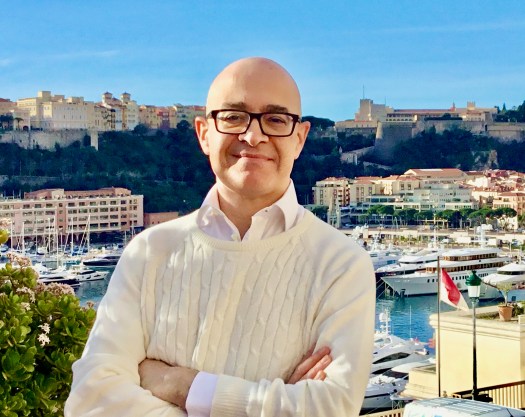
Born and raised in Monaco. Anais Berruti knew as a teenager she was gay. “I never had any problems with my family, friends, school, or workplace. I always accepted how I was and the most important thing for me was that my family accepted it. So, I have always been open about it. The fact that it was Monaco made no difference,” says Anais.
“But I know for my friends, who are Monegasque, it is more complicated because they feel that they are regarded negatively. I never had that feeling.”
Anais is one of four women who have co-founded Mon’Arc en Ciel, the country’s first LGBTQIA+ association. They will “defend and promote the individual and collective rights and freedoms of LGBT people in the Principality”, which is why they chose May 17 – International Day Against Homophobia, Transphobia and Biphobia – to launch their website.
Mon’Arc en Ciel was created last month by Anais and her wife Isabelle, and Laure Bernardi and her wife, Cynthia Salvanhac. The two couples each have a child less than a year old. As Anais explains, “We discovered as we were doing the paperwork to register our child at the crèche. On the one hand we are considered as a family in terms of our joint income, but on the other hand they say that my wife had no legal parental authority. I had to sign an authorisation for her to be able to pick up our child.”

The 35-year-old describes how she was “shocked and upset” about having to sign an authorisation for her wife. “She was there with me and I felt bad. I know that it wasn’t the fault of the director who was just passing on the information from her superiors. Legally, she had to do it. So I signed the authorisation.”
Immediately after, Anais sent an email to the crèche management to explain what had happened but the result wasn’t what she had hoped. “They called me and apologised, and said they would take a look at our file and put me as a single mother. Which wasn’t the idea at all. I had hoped that things had progressed, but in fact I was considered as a single mother and my wife doesn’t figure on the crèche documents.”
Anais and Isabelle discovered their friends were encountering the same situation. “This is what made us react, to change this, for us and for our children. Our goal is to have our family situation recognised.”
The idea of creating an association had been in discussion before Anais was pregnant. We thought it would be important for the future. But it was this issue with the crèche that made us actually do something.”
It’s not only the inequality at the nursery that Anais and Isabelle are facing. “My wife and I are resident and we work in Monaco and covered by the CCSS [Monaco’s social security] who take into account both of our incomes as a single household. When I was pregnant, I made an appointment with the CCSS to see if my wife was entitled to parental leave, in the same way that fathers have paternal leave when a child is born. And she is not. So, again, on the one hand they take our incomes into account but on the other hand we don’t have all the entitlements of a family. Even with the CCSS, in some services we are considered as a couple, but in others I’m considered as a single mother. It’s absurd.”

Anais says she feels well looked after in Monaco and doesn’t “feel any discrimination or judgement” when social services say that their hands are tied by the government, by the law, and that they can’t do anything. According to ILGA’s Rainbow Map, Monaco is the least developed among Western European countries in terms of LGBTQ+ equality and out of 49 European and Central Asian countries, only five rank lower than the Principality – Belarus, Russia, Armenia, Turkey, and Azerbaijan. The country’s low placement on the LGBTQ+ ladder is not helped by its failure to recognize legally binding marriages from other countries, which impacts civil and economic rights of couples.
And although Monaco rebuts that its hands are tied as its Constitution establishes Catholicism as the state religion, Malta, whose population is 96% Catholic, is ranked number on the Rainbow Map for equal rights for same-sex couples.
“There are a lot of people who live and work in Monaco who are paranoid. They think there is a risk because they have a false image of Monaco. I do not agree that there is any risk. Monaco depends on a certain image for its economy but the people who live and work in Monaco are very welcoming and there is not the danger that people believe. But people are afraid that it might affect their job. I don’t know anyone who has been thrown out of Monaco for being gay.”
Anais says, “Monaco is small, people talk. I have never been uncomfortable saying that I’m in a couple with a woman. But we are young. We are not the same generation as older people who have maybe had different experiences.
“Some individuals feel there’s a risk of being regarded negatively, so they keep quiet. We understand, and that’s also why we created this association. To tell these people that, even if they don’t want to speak out, the association will do it for them.”
You can become a member of Mon’Arc en Ciel, donate time and skills to their association or support their cause. See their website for more. Contact: 07 80 98 00 03 or monarcenciel@monaco.mc.
Article first published on May 17, 2024. Photos: Good News Monaco.
Mon’Arc en Ciel will be tackling social, economic and family rights.
Same-sex couples in Monaco are denied spousal rights under the retirement system and are subject to pay inheritance tax which heterosexual couples are not.
For gay couples with children in Monaco, it is not legal to adopt the stepchild from a previous marriage leaving the child’s welfare and placement up in the air should the biological parent die.
Monegasques who have a civil union (PACS) can neither adopt nor use IVF because neither option is permitted in Monaco for same-sex parents. Legally married gay couples are denied family allowance benefits for their child.
If a gay couple is legally married in France but lives in Monaco, and one of the partners is taken to CHPG hospital, the spouse will have no legal right to visit or to decide on any elements of treatment, including resuscitation.
Looks Who’s Talking LGBTQIA+
Marina Ceyssac, High Commission for the Protection of Rights
Jean Charles Gardetto, Lawyer
Christine Pasquier-Ciulla, Lawyer and National Council
Béatrice Fresko-Rolfo, National Council and General Rapporteur on the rights of (LGBTI) people: Committee on Equality and Non-Discrimination, at the Parliamentary Assembly of the Council of Europe (PACE)